Guidance /
Note: State and local Leagues do not need LWVUS permission to partner with an organization, join a coalition, or participate in an event. If a partnership or activity is nonpartisan and aligned with League values, the League board can decide and move forward. LWVUS involvement is only needed in the limited situations described in “When to Loop In LWVUS” below.
Our Nonpartisan Foundation
From its founding in 1920, the League made the choice to neither support nor oppose any political party or candidate for public office. This foundation of nonpartisanship continues today to ensure that the League's voice is heard above the tumult of party/partisan politics and has added strength to the League's positions on issues and has made possible wide acceptance of League voter service and other educational activities.
It is important to recognize that while the League's activities to influence public policy are not partisan by default, the public's understanding and perception of partisanship changes throughout history and is directly impacted by current events as well as geographic and regional dynamics. Additionally, those who oppose the reforms and issues the League is working on may claim the League's efforts are partisan to control how the League exercises its influence and power.
This does not mean the League should curtail its advocacy or limit the public policy issues it works to influence, or that it should default to checking with LWVUS. It means being mindful of the external environment when deciding how, when, and with whom to engage in public policy activities — a decision that belongs to the League board.
Partnership Decisions Belong to Your League Board
Working in partnership with other groups — through formal coalitions (large or small), or to plan one event or activity — is an effective way to build power and use resources to work on an issue. When considering a partnership, it's critical to first determine how the partnership will help advance the League's goals.
Leagues are sometimes concerned that a partner organization may eventually endorse a candidate or be perceived as supporting a candidate or party. That possibility, on its own, is not a reason to avoid working with a group your League would otherwise join or collaborate with. It is a factor to think through using the guiding questions below — and the decision is your League board's to make.
It is up to each League board to evaluate the conditions of its League, the political climate and traditions in its community, and the risks and impact of a partnership. There is no one-size-fits-all answer, and no requirement to seek LWVUS approval before deciding.
Note: It is up to each League board to evaluate the conditions of its League, the political climate and traditions in its community, and the risks and impact of a partnership. There is no one-size-fits-all answer, and no requirement to seek LWVUS approval before deciding.
When to Loop In LWVUS
One line is fixed, not a judgment call: Leagues do not organize, join, or partner on activities that are explicitly partisan in purpose — organized primarily to support or oppose a candidate or political party, rather than an issue. That's a flat no under the League's nonpartisan policy, not a question to bring to LWVUS.
Beyond that hard line, most partnership and participation decisions are entirely within your League board's authority. National input is genuinely useful only in these narrower situations:
- Your League would be entering a new coalition it intends to lead or initiate that includes partisan organizations (Leagues should not lead or initiate such coalitions; see FAQ 2).
- The partnership involves sharing significant financial or other resources and would benefit from a written agreement — LWVUS can help with templates and review, though the decision to partner remains the League's.
- Your League wants visibility, communications, or organizing support for a high-profile national day of action (see below) — this is a request for support, not a request for permission.
Outside of these situations, Leagues do not need to check in before partnering, co-hosting, joining a coalition, or attending an event.
National Days of Action
High-profile national days of action (for example, large-scale marches or coordinated days of action) sometimes create uncertainty about whether LWVUS must weigh in before a Local or State League can participate.
To be clear: if LWVUS has not taken an official position on a national day of action, state and local Leagues may still choose to participate, provided their involvement is nonpartisan and consistent with League values and positions. No national sign-off is required.
Leagues are encouraged — not required — to let LWVUS know when they plan to join a high-profile event, so national can offer visibility and support (for example, from your Regional Organizer or the communications team) if helpful.
Defining Partnerships
A partnership can take different forms and look a variety of ways. The most common forms of League partnerships are:
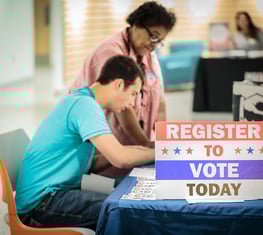
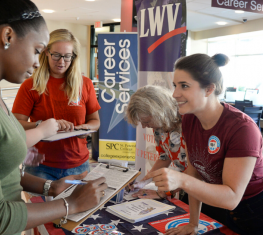
- Planning or hosting events together, such as voter registration drives, educational forums, or candidate forums.
- Joining formal coalitions that focus on advancing one or more League goals or priorities at the local, state, and national level.
- Informal/ad hoc relationships in which League leaders may: attend another organization's event; speak at a press conference or rally; invite an organization to speak at a League-sponsored event; or speak at another organization's event.
Most partnerships and coalitions do not require a formal agreement or memo of understanding/principles document, though some might. LWVUS recommends putting in writing any agreement where financial or other significant resources are being shared between organizations — and is available to help if useful, not as a required checkpoint.
Questions to Guide Your League's Decision
These questions are tools for your League board's own decision-making — not a checklist to submit to LWVUS.
- How will this opportunity help the League reach its organizational, strategic, and operational goals?
- Does this opportunity help the League realize its commitment to diversity, equity, and inclusion in principle and in practice?
- If it doesn't directly serve our goals or fill an existing gap, is it still worth doing for other reasons?
- Who is missing from the coalition that should be at the table?
- Does this partnership bring increased visibility or revenue possibilities to our League?
- What specific added value can we offer this potential partner?
- How do our values and priorities align with this partner?
- Will this partnership directly benefit or engage our target audiences and/or underrepresented communities?
- What is the commitment being asked of the League in terms of time and other resources? Is what they're asking of us reasonable and doable for our League?
- What does our League need from the relationship to make this worth our while?
- Is this potential partnership with a PAC, c3, c4, etc.? How might that shape the nature of their work and the intention for partnering with the League?
- How does this partnership align with our commitment to our public policy positions?
- What, if anything, is stipulated in our state or local League bylaws or organizational policies that pertain to partnerships?
- What doors would this partnership open for our League? Would this partnership close any doors for our League?
- Are there partisan organizations involved and, if so, is there a political balance within the coalition? Is the coalition large enough and balanced with enough other nonpartisan organizations?
- Will the coalition as a whole, or individual organizations within it, be endorsing candidates?
- What are the risks of foregoing the partnership versus joining it?
Frequently Asked Questions
- Does the fact that an organization endorses or opposes a political party or candidate mean our League cannot partner with them?
-
No. Leagues can partner with organizations that endorse or oppose political parties or candidates, as long as the partnership itself is nonpartisan in nature. The decision is your League's to make, using the guiding questions above — including these two additional considerations:
- The timing of the partner's or coalition's endorsement (e.g., how close to the event will the endorsement come out).
- The balance of groups that endorse candidates versus those that do not.
The one firm limit: Leagues should not belong to or join coalitions or enter into partnerships that are primarily focused on supporting or opposing candidates or parties. Short of that, the choice is the League's.
- Our League participates in a coalition that includes partisan organizations. Is that OK?
-
Yes, in most cases — and no LWVUS approval is needed. Coalitions are important frameworks to build power and move work. Leagues may join established coalitions that include partisan organizations. The one exception: Leagues should not lead or initiate a new coalition that includes partisan organizations, and should not join a coalition that a partisan organization is leading.
Beyond that distinction, use these questions to inform your League's own decision:
- Is there an over-representation or sole representation of one major political party?
- How big is the coalition? While there is no specific threshold, the smaller the coalition, the less desirable it is for a League to join if there are partisan members.
- Are partisan organizations from across the political spectrum actively invited to join?
- Is supporting Black Lives Matter partisan?
-
No. Black Lives Matter (BLM) is a movement and is not partisan. Per BLM's webpage, its mission is to eradicate white supremacy and build local power to intervene in violence inflicted on Black communities by the state and vigilantes. (Source: BLM website) Even though others may claim the issues that BLM addresses are partisan, issues are not partisan.
It is critical that the League stands in solidarity with the Black community and lifts up these voices as we work together to fight against systemic racial injustice and inequalities. The League can be a strong ally by standing firm against claims that this work to dismantle systemic racism is partisan, because it simply is not. (Read more)
- Can LWVUS provide a vetted list of nonpartisan organizations or “approved organizations”?
-
No — and this is by design, not a gap. With the ever-changing landscape of coalitions and partnerships, a static list would go stale immediately, and organizations often operate differently from state to state or community to community. A local organization in one state may take on partisan activities while the same affiliate elsewhere does not. Your League board, closest to local conditions, is best positioned to make this call using the guiding questions above.
- Can our League partner with organizations whose board members or staff are former elected officials?
-
Yes. LWVUS does not prohibit Leagues from partnering with organizations led by former elected officials. The main consideration is not a person's past association or role, but whether they are currently serving in a role, or at an organization, that is aligned with the work of the League. Use the guiding questions above to think it through.
- Are there visibility considerations Leagues should think about when partnering at public events?
-
A few practical, easy-to-apply habits go a long way at public events such as rallies or tabling events where campaigns or partisan groups are also present:
- Avoid proactively participating in a partisan group's photos or videos.
- When sharing photos on your League's own platforms, favor images that reflect the League's presence and message rather than a partisan group's branding.
At public events with many phones and cameras, your League members may inadvertently appear in the background of others' photos and videos, or others may appear in yours. This is normal and expected at public events — it does not create a partnership or endorsement, and no follow-up or reporting is needed. The simple goal is to avoid the appearance of partnership where you reasonably can, not to police every photo.