Why It Matters
Voter suppression is any attempt to prevent or discourage certain Americans from registering to vote or casting their ballot. These measures often target specific groups based on race, ethnicity, political affiliation, age, or other aspects of voters’ identities. The most widely used forms of voter suppression include discriminatory voter ID and proof-of-citizenship restrictions, reduced polling place hours in communities of color, the elimination of early voting opportunities, and illegal purges of voters from the rolls.
Historically, voter suppression has overwhelmingly targeted Black Americans. After the Civil War, Black men were able to participate in elections once the 15th Amendment to the US Constitution was adopted in 1870, which states:
“The right of citizens of the United States to vote shall not be denied or abridged by the United States, or by any State, on account of race, color, or previous condition of servitude.”
Voter suppression in southern states raged in the form of laws to prevent poor and Black voters from participating in elections. These laws, known as Jim Crow laws, included poll taxes and literacy tests. Many of these voter suppression strategies remained in place until the 1965 passage of the Voting Rights Act.
In 2013, the US Supreme Court removed key protections of the Voting Rights Act in the decision of Shelby v. Holder. Since then, a surge of anti-voter bills have swept across our nation– with many being legalized.
The League will not stand for this.
Example: Ohio
The Right to Voting Assistance (League of Women Voters of Ohio v. LaRose)
LWV Ohio and Jennifer Kucera, an Ohio voter with muscular dystrophy, filed a federal lawsuit against several provisions of HB 458 (which imposed several significant restrictions on assisting voters with returning their absentee ballots). LWV Ohio and Ms. Kucera asserted the provision violated the Americans with Disabilities Act, the Rehabilitation Act of 1973, the Voting Rights Act of 1965, and was unconstitutionally vague under the Fourteenth Amendment’s Due Process Clause.
Example: Alabama
Halting Illegal Voter Purges (Alabama Coalition for Immigrant Justice et al. v. Allen et al.)
Campaign Legal Center, Alabama voters, and civil rights groups successfully defended naturalized Americans who were unfairly purged from Alabama’s voter rolls. A federal judge halted Alabama’s illegal and last-minute purge program, which put the freedom to vote for thousands of Alabamians in jeopardy, holding that Alabama could not systematically remove voters from the rolls in the 90 days before the 2024 general election.
Support the fight for everyone's freedom to vote.
What We're Doing
Legal Work
The League is at the forefront of the most important federal and state cases across the United States. Our legal team works tirelessly to oppose all forms of voter suppression, including:
- Discriminatory voter ID laws;
- Attacks on voter registration;
- Last-minute Election Day barriers;
- The elimination of voting locations in underserved communities;
- Unjust voter purges; and
- Attempts to limit access to early and mail-in voting.
Advocating to End Voter Suppression
We support legislation that empowers Americans to participate in the voting process. These include:
- Expansion of the Voting Rights Act: More than 50 years after the Voting Rights Act was passed, full protections for voting rights are not guaranteed for all voters. Many people still face challenges to participating in elections due to factors including income, health, age, race, disability, and gender. Voting is a fundamental right, and all Americans deserve an equal opportunity to make their voices heard in our democracy.
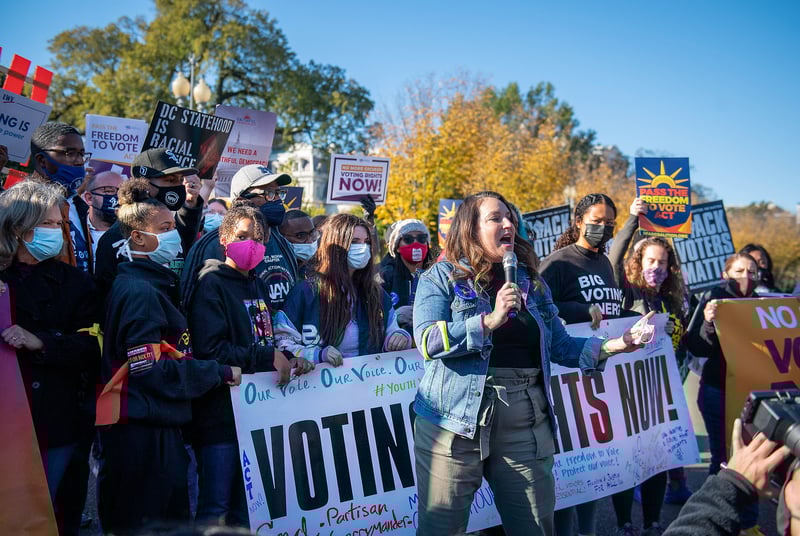
- DC Statehood: Over 700,000 DC residents pay taxes, are eligible for the military draft, and contribute to our nation and their community the same as residents of every other state, yet they are without full representation in Congress. The majority of these Americans are people of color. We support full statehood and representation for the people of DC.
Take Action
- Urge your representatives to pass voting rights legislation!
- Sign up for our email list and/or digital organizing app to stay updated on breaking news and ways to take action
- Spread the word about voter suppression by sharing this page with your friends and family on social media
In a victory for Utah voters, the Utah Supreme Court allowed Utah voters to move forward with their claim that the Legislature illegally gutted a citizen-led anti-gerrymandering initiative.
LWVUS joined a letter to the House of Representatives in opposition to the Safeguard American Voter Eligibility (SAVE) Act.
LWV Wisconsin filed an amicus brief in support of a challenge to three absentee voting rules, including a ban on ballot drop boxes
Stay Updated
Keep up with our work to end voters suppression.
Donate and support our work
to empower voters