



The most recent Supreme Court term came to a close with monumental decisions in several cases. This included major wins regarding birthright citizenship and mail-in voting, but also critical losses around campaign finances and transgender rights.
In light of the Supreme Court’s many controversial decisions in recent years, many people have called for its expansion. The desire to expand SCOTUS is rooted in the hope that doing so would allow the appointment of judges who are more aligned with the desires of the people.
This concept, “court packing,” is an old political strategy. The most famous example occurred in 1937, when President Franklin Delano Roosevelt (FDR) sought to add justices who supported his New Deal.
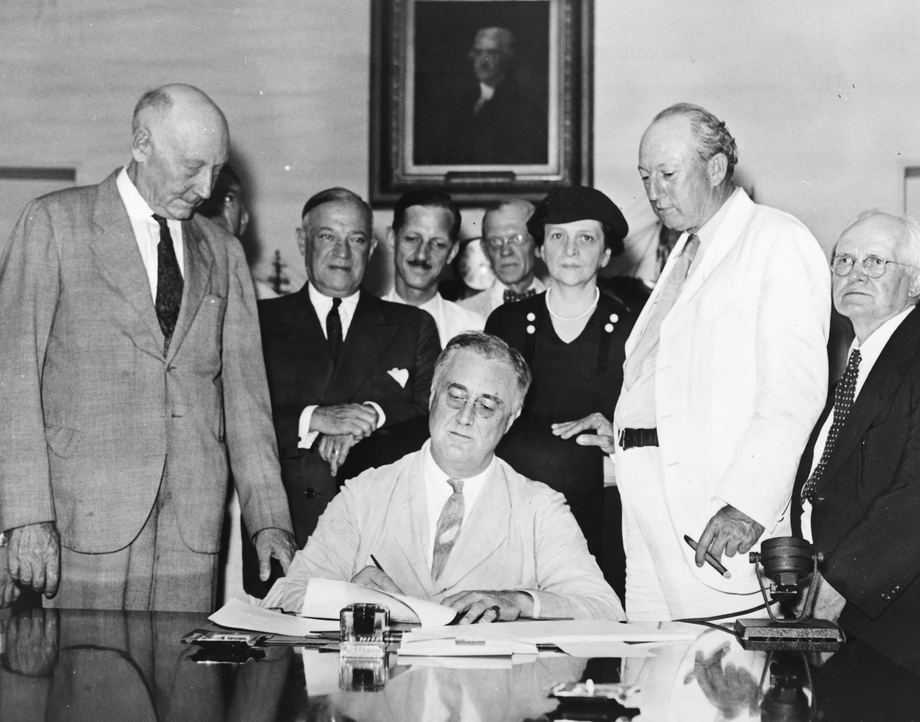
President Franklin Delano Roosevelt signing the Social Security Act into law
Below, we’ll review the history of court packing, why it hasn’t been successful, and what lessons we can learn from past attempts.
A Hostile Court in 1937
While the Court’s size has varied over time, no president has yet succeeded in adding justices to outvote a majority opposed to them. The last serious attempt came in 1937, when President Franklin Roosevelt, freshly reelected with 523 electoral votes and a popular vote of over 27 million votes to his opponent’s nearly 17 million, confronted a conservative Court that repeatedly struck down legislation underpinning his New Deal.
When President Roosevelt took the oath of office a second time on January 20, 1937, the Court was split into multiple factions. The conservative “Four Horsemen,” Justices George Sutherland, Pierce Butler, James McReynolds, and Willis Van Devanter, were considered hostile to the New Deal and repeatedly struck down federal legislation regulating the national economy.
Stay Updated
Keep up with the latest Supreme Court and democracy news. Receive emails to your inbox!
On the other end of the spectrum were the so-called “Three Musketeers,” Justices Louis Brandeis, Benjamin Cardozo, and Harlan Fiske Stone, who tended to side with the administration and usually voted to uphold New Deal and pro-worker legislation.
The two remaining Justices, Charles Evans Hughes and Owen Roberts, were considered conservative swing votes.
Black Monday and Further Losses
The Court that greeted President Roosevelt’s second term was already seen as hostile to government regulation of the economy. And on a single day, Monday, May 27, 1935, before the president achieved a smashing reelection, the Court decisively struck down several pieces of New Deal legislation.
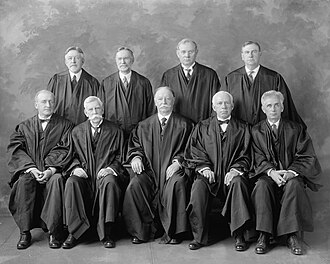
The Supreme Court justices in 1925, including the "Four Horsemen" James McReynolds, George Sutherland, Willis Van Devanter, and Pierce Butler
Among these were:
- A.L.A. Schechter Poultry Corp. v. United States: A unanimous decision striking down the National Industrial Recovery Act, which allowed the President to impose certain codes on various business sectors, including the introduction of fixed prices and wages and production quotas.
- Humphrey's Executor v. United States: The Court ruled President Roosevelt did not have the power to fire William E. Humphrey, a member of the Federal Trade Commission, except for the causes specified in the Federal Trade Commission Act.
- Louisville Joint Stock Land Bank v. Radford :A unanimous decision which found that certain reforms to bankruptcy law aiding financially distressed farmers violated the Fifth Amendment.
Further cases invalidating New Deal legislation and pro-worker state laws also followed. In Carter v. Carter Coal Co., the Court ruled that the Commerce Clause did not allow Congress to regulate working hours, labor practices, and other policies on workers in the coal industry. A further decision in Morehead v. New York ex rel. Tipaldo struck down a state law requiring fair wages for women.
FDR’s Court Packing Plan
On February 5, 1937, President Roosevelt unveiled a bill which, among other provisions, allowed him to add up to 6 justices to the court for each justice who did not retire or resign after six months upon reaching the age of 70.
In a March 9, 1937, radio address promoting the plan, the President did not explicitly state that adding justices was a way to override the Court’s conservative majority. Instead, he made two main arguments.
The first was that the scale of the Great Depression necessitated a national response, and that Congress, empowered by the Constitution and the founders with broad powers, had taken appropriate action by passing legislation to address the crisis.
The second was that the Court’s repeated invalidation of various laws enacted in pursuit of this objective was an act beyond constitutional boundaries. In other words, the Court’s conservative majority had appointed itself a super legislature and continued to override Congress based upon its members’ own personal conservatism.
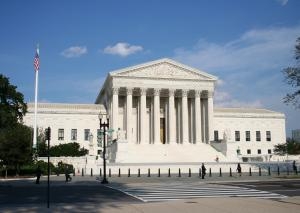
Adding new justices would, according to the President, ensure the swift administration of justice and bring in fresh perspective. But this sales pitch did little to move the plan along.
The Country’s Reaction to FDR’s Court Packing Plan
Even among his own party, support for Roosevelt’s plan was tepid at best. Congressman Hatton Sumners of Texas, Chairman of the House Judiciary Committee, bottled the bill up in his committee, forcing the administration to try and pass the bill in the Senate first.
Upon its introduction to the Judiciary Committee, the plan soon floundered.
Senate Judiciary Committee Chairman Henry Ashurst of Arizona waited 165 days before calling up the bill to be considered, stating, “No haste, no hurry, no waste, no worry — that is the motto of this committee.” This was hardly a ringing endorsement of one of the President’s top priorities.
In the end, when the Senate Judiciary Committee released its report on the bill on June 14, 1937, the contents effectively sentenced the President’s court-packing plan to death. The Senators condemned the bill as doing nothing to introduce new blood into the judiciary, pointing out that assuming no members of the current Supreme Court retired or died, no new judges could be appointed unless mandatory retirement at a certain age was enforced. Under the bill, the President could also appoint older judges. According to the report, these provisions contradicted the idea of introducing ‘new blood’ into the judiciary.
As for the charge that the Court had overstepped its boundaries and infringed upon Congress’ role in the passage of legislation, the report stated that even if that were true, the proper remedy was to simply wait out the conservative majority and replace them once they retired or died. The alternative, in the view of the undersigned senators, would undermine judicial independence and make the executive and legislative branches the interpreters of the Constitution, subject to the changing ideologies of those branches.
Combined with the death of Senate Majority Leader Joseph Robinson of Arkansas, who had championed the plan, on July 14, 1937, the court-packing plan died quietly in Congress.
The New Deal’s Eventual Triumph and the Lessons for Today
Of course, while the court-packing plan was sinking in Congress, the Court itself was still hearing cases, many of which challenged the administration’s New Deal policies.
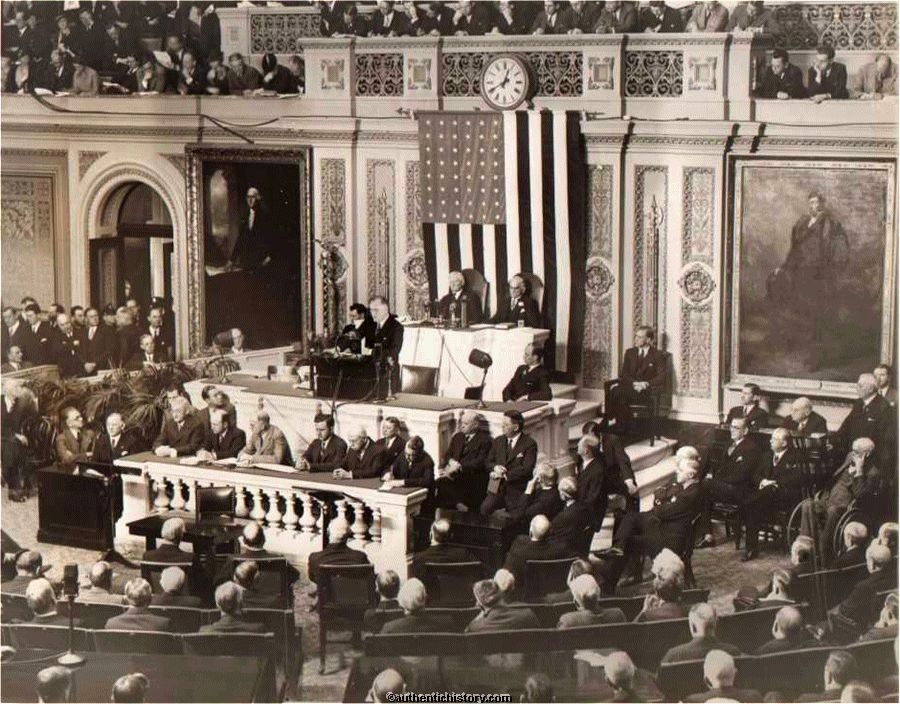
FDR addressing Congress in 1941
By the time the 1936-1937 term ended, observers noted a massive shift in the Court’s willingness to uphold New Deal policy.
Several examples of this shift included rulings in:
- West Coast Hotel Co. v. Parrish: The Court upheld a Washington state minimum wage law, overturning a previous case, Adkins v. Children’s Hospital, which stated a federal minimum wage law violated the freedom of contract under the federal Constitution.
- NLRB v. Jones & Laughlin Steel Corp: A decision upholding the constitutionality of the National Labor Relations Act of 1935 and the federal government’s authority to regulate labor disputes.
- Steward Machine Co. v. Davis: A decision upholding a tax in the Social Security Act imposed upon employers of eight or more employees to fund unemployment compensation.
Justice Roberts’ shift in voting to uphold New Deal legislation is sometimes called “The Switch in Time that Saved Nine.”
Regardless of the motives, the effect was clear. The Court had decided to stay its hand from striking down integral parts of the New Deal, and this shift would be bolstered by two further developments.
First, Justice Willis Van Devanter, a member of the conservative bloc of the Court, the so-called “Four Horsemen” retired on June 21, 1937. He would be replaced in August 1937 by Alabama Senator Hugo Black, a staunch New Deal supporter who had originally supported the court-packing plan. Justice Van Devanter’s retirement was then followed by conservative Justice George Sutherland’s retirement in January 1938, allowing Roosevelt to replace him with Stanley Reed, who had served as Solicitor General and defended many New Deal policies before the Court.
By the time he died in 1945, Franklin Roosevelt had appointed seven of the nine justices of the Court, ensuring his New Deal policies would survive him for decades to come. His eventual success, and the failure of his court-packing plan, are instructive for would-be Court reformers today.
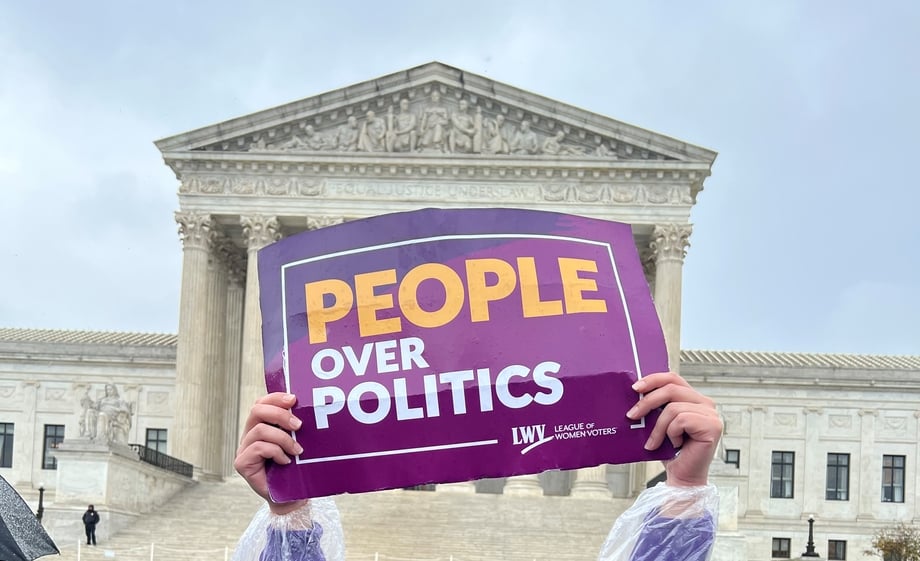
Recent Calls to Expand the Supreme Court
In the late 2010s, the Supreme Court underwent a shift to the political right due to:
- The Republican-controlled Senate’s blockade of Merrick Garland’s appointment to the Supreme Court in 2016,
- The death of Justice Ruth Bader Ginsburg, and
- The subsequent appointment of three Justices by President Donald Trump to the Court
Many commentators called upon Democrats to expand the court’s size and counteract the conservative shift.
For the ordinary voter frustrated about the current Court, with its numerous corruption scandals, refusal to engage in meaningful oversight or ethics regulation, and destruction of reproductive freedom, voting rights, and the separation of powers, the fate of the court-packing plan provides several insights.
President Roosevelt may never have considered adding justices if he had not been reelected with a Congress that was favorable to his views. Only a unified legislature and executive can create laws and impose discipline on the Court.
Second, the fate of any Court reform depends on the legislature’s sustained commitment to a clear plan. Franklin Roosevelt’s court packing plan died when key members of his own party overwhelmingly refused to go along with it and blocked it in Congress. Had the Democratic party been more strongly aligned with Roosevelt’s plan, it would likely have succeeded.
The real hope for change comes from a basic truth about our democracy: elections matter. Franklin Roosevelt eventually triumphed over the conservative Four Horsemen by simply waiting them out. Eventually, as they retired one by one, he was able to appoint new Justices who shared his views, turning the Court towards a far more friendly posture towards the New Deal.
As frustrating as the Court can be, no Justice can stay forever. If the American people do not enjoy the current rulings of the Court, then they must vote in a President and Senate who will stand ready and willing to appoint replacements more to their liking. It is a slow and frustrating process, but no Supreme Court majority is permanent, as the Four Horsemen eventually discovered.