
This op-ed was published by The Hill
by Celina Stewart and Lucille Wenegieme, opinion contributors
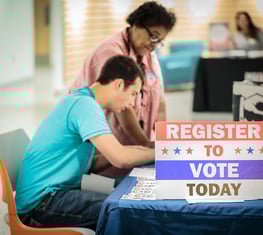
In every generation, Americans have stepped forward to help their friends, family and neighbors register to vote.
Whether it’s stopping at a booth during a concert or receiving assistance after a naturalization ceremony, the process of voter registration in the United States has never been solely the work of our government. It has always been a shared and celebrated responsibility, with civic groups providing the energy, equity and local communities that government institutions struggle to reach.
That history matters today, as the Department of Homeland Security has moved to restrict voter registration at naturalization ceremonies, and others cast doubt on the appropriateness of nonpartisan civil society groups supporting voter registration.
Registering voters is one of the most meaningful and symbolic expressions of civic participation. Rolling back that tradition at naturalization ceremonies diminishes a practice rooted in our nation’s democratic fabric: citizens helping citizens take the first step into civic life.
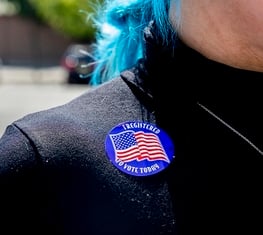
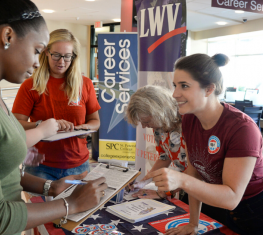
For decades, our organizations — the League of Women Voters and HeadCount — have attended naturalization ceremonies, offering new citizens the chance to register on the very day they become Americans, or been present at concerts, festivals and community events around the country full of young, newly eligible voters.
In 2025 alone, our organizations have registered over 35,000 new Americans — a small stadium’s worth of new people — into our democratic process. But now that work has been drastically reduced due to the new policy.
It is important to remember how independent voter registration emerged in the first place. It was needed to support the government because the U.S. never built a comprehensive system for automatically enrolling eligible voters. Instead, it relied on election officials, political parties, civil society and individuals.
The history of third-party registration drives shows us that marginalized communities were systematically excluded from the ballot box.
Nonpartisan civic organizations stepped in to fill those gaps, not just with paperwork, but with trust, outreach and education. In many cases, these groups did what the government would not — or could not — do.
During the civil rights movement, volunteers risked their lives to register Black voters in the South, when local officials actively resisted. In the decades that followed, nonpartisan organizations worked in schools, libraries, community centers and other public spaces to ensure Americans had the education and resources they needed to register to vote.
Their efforts made democracy more equitable by reaching those who were least likely to be invited into the system.
That spirit continues today at naturalization ceremonies, Chappell Roan or Green Day concerts, local community college campuses, libraries or online — often turning casual encounters into moments of education that grow into a lifelong habit of civic participation.
These moments are not about bureaucracy; they’re about belonging. They are about making democracy real, accessible and joyful for all Americans.
Critics sometimes argue that only the government should handle voter registration. Election officials have long expressed their needs: more money, more time, more resources — but new legislation will cut election administration funds by nearly 40 percent, according to R Street.
This depletion further emphasizes that government leadership is not enough. Without independent civic engagement, voter registration in this country would be narrower, less equitable and less trusted.
Third-party registration drives are not in competition with government systems; they complement them. They build bridges into communities where government institutions may not have reach or credibility. And they embody the core American value that democracy is not a spectator sport; it is something we build together and it begins the moment you become an eligible voter.
In limiting these opportunities, the Department of Homeland Security is sending the message that voter registration is a bureaucratic formality rather than a civic milestone. Worse, it further burdens election officials who are already overworked and stretched in capacity.
We know what works to register voters because we have done the work for decades. When a young person registers to vote between sets at a concert, they are stepping into civic life in an environment that feels like their own. When a new American registers moments after taking the oath, they are affirming that citizenship and participation belong together.
These are powerful, formative experiences that no government office can fully replicate on its own.
Democracy in the United States has always depended on more than government — it has depended on us, the people, lifting one another into participation and civic life. That is the legacy of independent voter registration, and it is why we must defend it and where possible, expand it.
The Department of Homeland Security should restore civic access at naturalization ceremonies, and leaders at every level should welcome nonpartisan third-party groups as essential partners in filling this gap. Because when it comes to registering voters, history has shown us one thing again and again: Government alone is not enough. Democracy is strongest when citizens themselves open the door for others to walk through.
Celina Stewart, Esq., is chief executive officer of the League of Women Voters of the United States. Lucille Wenegieme is the executive director of HeadCount.
###