
Few things are more deeply woven into the story of the United States than immigration.
After all, with the exception of Indigenous Americans and the descendants of enslaved people, every one of us is from an immigrant family...it's just a matter of generation. We, or our parents, or our “great greats,” came here from a foreign land, carrying hope for a better life. I myself left my home country of Bangladesh (more on that later) to come to the United States for college, and clearly, I stayed!
Stay Updated
Keep up with the League. Receive emails to your inbox!
That's what the promise of our nation has always been: that people who are willing to take a chance and work hard can unite to build a better world. That's what brought English immigrants to Massachusetts Bay Colony as they fled religious persecution. That's what united immigrants across several nationalities as they literally constructed our nation in 1776. From our nation's founders down through succeeding generations to today, our nation of immigrants has consistently worked to build a better world, imperfect though it might be.
Snippets of My Bangladeshi American Story
As mentioned earlier, I myself am an immigrant from Bangladesh. I was a little girl during the Bangladesh Liberation War, a conflict born in many ways out of a failure to celebrate the diversity within what was previously one nation.

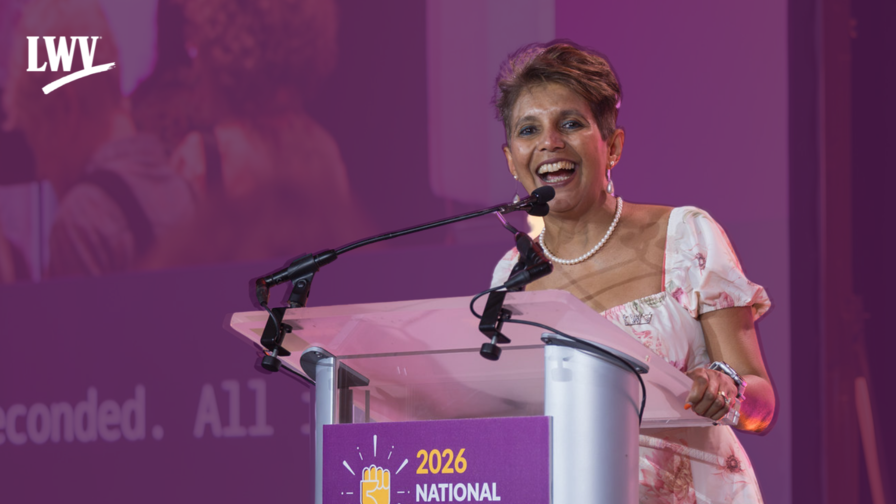
The author with CEO Celina Stewart, Esq.
While I was very young during that conflict, certain memories — particularly those that still recall the emotions of fear comingled with resolution to secure one’s freedom — are imprinted on my brain. Perhaps this is why themes of cultural diversity, identity, and justice are resonant themes for me.
I came to the United States for college. In Bangladesh, as in many other countries, when you go to college, you need to know exactly what you plan to major in. You apply not just to a school, but to a specific department, such as literature or mathematics or electrical engineering. If you decide to change your focus, you need to reapply and restart your college program. But in the United States, students are encouraged to explore different fields and advance their knowledge across many subjects to find where their future lies.
What a fitting metaphor for this country itself!
Studying history alongside music and theater can lead to artistic creations like the smash hit Hamilton, which famously celebrates the contributions of immigrants. Bringing medicine and the social sciences together can lead to trauma-informed healthcare. Integrating ecology and engineering can help produce sustainable solutions to environmental challenges.
I was just one of many international students who chose to study in the United States. Former Secretary of State Madeleine Albright, Oscar-winning director Ang Lee, and Sanjay Mehrotra, a co-founder of SanDisk, are just three of countless immigrants who studied at American institutions and went on to shape life and culture in the United States. I’m proud to live in a nation whose strength, as President Reagan said, derives from the way it brings people of different origins and experiences together in pursuit of a better world.
A Product of Multiculturalism and Immigration
How have immigration and multiculturalism formed and altered our nation? To get into that, I want to take a brief detour into an unexpected area: engineering.
When I came to the United States, it was to study computer science and mathematics at the University of Rochester, then graduate work in computing performance and electrical engineering at Northwestern University.
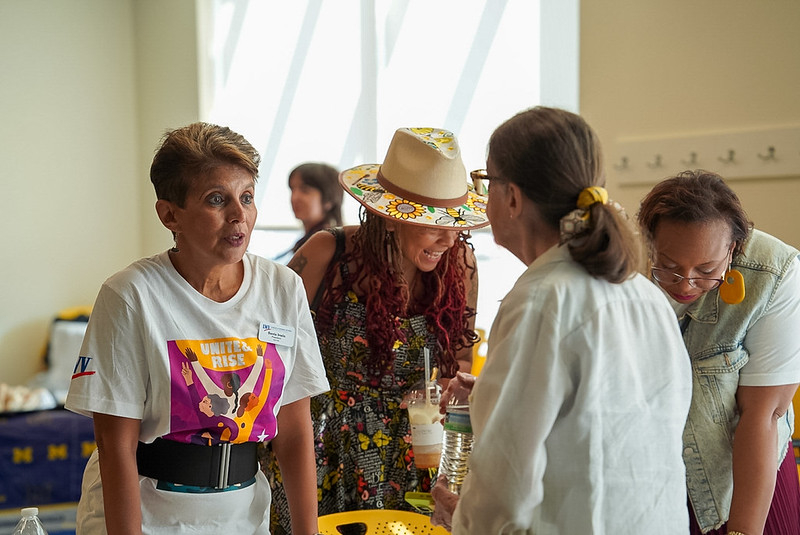
Sania Irwin at an event for Unite and Rise
Many people believe engineering and technology are cut-and-dry disciplines, built on quantitative answers and systematic thinking alone. While part of that is true, it could not be farther from the whole truth.
My engineering education taught me that important advances happen when people with different perspectives are in the same room, generating and refining ideas together. Today, through my service on a Northwestern University board, I see how much international students continue to contribute to classrooms, teaching, graduate education, faculty research, and innovation.
It is deeply troubling that as the world's most talented students are evaluating higher education options today, fewer see the United States as their ideal destination.
The ability to listen and to meld ideas to create something better is how science and society advance.
We can see this when we look at our country’s evolution. Our democracy was influenced not only by the oft-lauded Greeks and Romans, but also by Indigenous political systems such as the Iroquois Confederacy, as well as early civilizations in Mesopotamia (largely situated in modern-day Iraq) and India. Women's suffrage took cues from the Six Nations Haudenosaunee Confederacy. Agricultural practices, legal infrastructures, religious traditions, and more came together from European, African, Indigenous communities, and beyond.
President Ronald Reagan acknowledged the critical role of immigration in American culture in a 1989 speech:
"We lead the world because unique among nations, we draw our people—our strength—from every country and every corner of the world. And by doing so we continuously renew and enrich our nation…If we ever closed the door to new Americans, our leadership in the world would soon be lost."
Today, immigration continues to advance our nation. The cultural impact is obvious to anyone who has enjoyed foods such as pizza, egg rolls, or hummus, or music such as salsa, K-pop, or jazz. Beyond its influence on our food, music, film, literature, and other cultural touchstones, immigration has also strengthened our economy, healthcare system, agricultural sector, advances in science and technology, and much more.

A 2026 study showed that American metropolitan areas whose foreign-born, working-age populations increased also “saw stronger growth in gross metropolitan product (GMP) and employment...as well as in key prosperity metrics such as productivity and wage growth.” In other words, cities whose working-age immigrant populations increased saw more economic and lifestyle improvements. That included higher employment rates among both foreign-born and native workers.
Immigrants also sustain critical industries, including healthcare and agriculture. They play an especially important role in our healthcare system: immigrants account for 28% of physicians and surgeons and 30% of direct-care workers in long-term-care settings. They are also essential to our food system, representing a significant share of the nation's agricultural workforce.
I could cite many more examples of the ways immigrants continue to shape our country for the better. The bottom line is clear: our multicultural population is one of the United States' greatest strengths.
Yet some current policies are pulling us away from that strength...and from the ideals our nation has long aspired to uphold.
When Policies Conflict with Ideals
The diverse, immigrant-shaped culture that makes the United States unique depends on policies that recognize the dignity, rights, and contributions of every person.
Policies involving surveillance, detention and deportation, birthright citizenship — which the League fought to uphold, and won! — and proposed changes to who is counted for congressional apportionment in the Census raise urgent questions about whether we are living up to those principles. When government policy treats rights and freedoms as contingent on a person's immigration status, identity, or how others perceive them, the consequences reach beyond any one community. They test the meaning of equal protection and human dignity for everyone.

That is not consistent with the democratic ideals the United States claims — and must continue striving — to uphold.
What Do the Statistics Show About the Impact of These Policies?
The available statistics show the scale and human impact of these policies. As of July 2026, more than 350,000 people had been deported, with nearly 1,500 arrests per day in June 2026. As of June 2026, at least 52 people had died in ICE custody; that period also saw fatal encounters during ICE enforcement operations. Reported hate crimes against Latinos also reached a record high in 2025.
These statistics are reflected in daily life. As of late 2025, half of immigrants surveyed — regardless of immigration status — reported feeling less safe amid intensified immigration enforcement. Three in ten reported avoiding travel, work, public spaces, or medical care.
While the human costs are terrible enough and paramount, there are economic costs as well. Despite ICE's work being promoted in part as a way to "remove unauthorized workers and create jobs for Americans," enforcement surges in 2025 actually cost more than 668,000 jobs, with employment falling by .73% in the cities with the sharpest rises in ICE arrests. That included 51,000-297,000 jobs that would have been held by American-born workers.
International student enrollment in US schools is facing a historic decline, with an estimated 111,000 fewer international students in Fall 2026 (and a related $3.4 billion revenue loss).
The way the world sees the United States is also changing. We have long pointed with pride to the Statue of Liberty and its invitation to those "yearning to breathe free." Yet in August 2026, I was struck by a cover of The Economist titled "The Unwelcoming States of America." It depicted a US flag made not of stars and stripes, but of barbed wire, beneath the words "KEEP OUT!"
When We Protect Immigrants, We Protect the United States
Policies that diminish immigrants' rights and dignity run counter to the ideals of this nation, and pull us farther from the more perfect union we have always striven to become.

I am deeply troubled by the inhumanity we are witnessing. How can we call ourselves a land of liberty while denying people their human rights? How can we remain a beacon to the world while closing ourselves off from it?
But we must be hopeful. And as with generations of Americans, I look to a diverse group of people to give me hope.
I look to the American revolutionaries who fought for a representative nation, and the abolitionists, suffragists, and civil rights activists who demanded we make that promise available to all people. I look to the people of Bangladesh, who refused to have their rights denied or their culture erased. And I look to so many people around the world, carrying beacons of hope across the world, through their words and in their suitcases, in their actions or on their backs.
I listen to those people the same way I learned to listen as an engineering student. And drawing together their stories, from across the world, I am emboldened.
To get involved in your community, search our 800+ state and local Leagues.
We can act. We can support immigrant friends and neighbors with Know Your Rights information and de-escalation resources. We can demand that Congress uphold a Census that counts every person. We can challenge anti-immigrant rhetoric and hate speech when we encounter it. And we can elect officials who respect human dignity, immigrant lives, and the democratic principles that protect us all.
There are surely many more ways to help that I have not yet considered…ideas someone else, drawing on their own knowledge, life story, or country of origin, may share with me.
I am listening. Are you?