





How Does Redistricting Work?
The Census and Apportionment
Every ten years, the US Census Bureau counts the United States population and uses the updated counts to determine which state populations have increased or decreased.
These new population counts are used to decide the number of representatives that each state in the country receives. By federal law, the size of the House of Representatives is set at 435 seats, but the number of elected representatives and their district areas change over time. This process is known as apportionment.
- Example: Based on the data released in the 2020 census, Colorado, Florida, Montana, North Carolina, and Oregon’s populations grew, so they each gained a district and, therefore, one Congressional representative. Texas gained two districts and two representatives.
It’s crucial that the Census Bureau has sufficient time to carefully collect and review their data. Otherwise, we risk undercounting the population. The more complete the population count, the more likely districts will reflect our communities.
Redistricting Files
Following apportionment, more detailed information is released to each state (plus DC and Puerto Rico) in the form of “redistricting files.” This information includes details like race, voting age, and more. Once it is released, states can begin the redistricting process.
Drawing Our Communities
There is no universal process for drawing district maps, so states use different methods. These include:
- Redistricting commissions: 17 states currently give some form of redistricting commission responsibility over the map-drawing process. The commission may be made up of voters residing in the state (independent commissions), voters and representatives from both parties (bipartisan commissions), legislators (advisory commissions), or a backup group if the primary commission is unable to create new maps (backup commissions).
- State legislators: 33 states currently assign redistricting to their legislators. Unfortunately, with legislators drawing their own boundaries, there is ample room for political bias and gerrymandering.
Support the fight for everyone's freedom to vote.
Midcycle Redistricting
Midcycle redistricting occurs when states redraw their maps outside of the normal 10-year cycle. It is commonly used as a partisan strategy to increase certain politicians' power and reduce electoral competitiveness.
In the mid-2020s, instances of midcycle redistricting surged as this technique became a major tool for politicians to protect and increase legislative majorities.
The Threat of Gerrymandering
Historically, politicians have manipulated the redistricting process to expand or protect their own power—often to the detriment of the minority political party, marginalized populations, and often, Black communities. This manipulation is called gerrymandering.
There are two primary methods of gerrymandering:
Racial Gerrymandering:
When mapmakers draw boundaries to either benefit or disenfranchise members of a certain race.
Example:
In March 2022, the Louisiana legislature passed a new congressional map with only one majority-Black district, which combined heavily Black cities. Several lawsuits were filed in which plaintiffs argued the map divided Black communities and diluted their voting power. The map was subsequently struck down, and in January 2024, the Louisiana legislature drew a remedial map with two majority-Black congressional districts.
Mere weeks later, several plaintiffs filed a lawsuit against the remedial map, arguing it was racially gerrymandered and requesting a new map be imposed. On April 29, 2026, the Supreme Court issued its opinion in Louisiana v. Callais. The 6-3 majority destroyed the remainder of Section 2 of the Voting Rights Act, spurring a redistricting frenzy across the country to draw new maps eliminating majority-minority districts.
Political Gerrymandering
When maps are drawn to increase or decrease the influence of a particular political party.
Example:
In 2016, Maryland elected Democrats to seven of their eight Congressional seats, despite the fact that Democrats earned roughly 60% of the popular vote. While the Supreme Court failed to find that partisan politics played too strong of a role, many people believe this was a clear case of partisan gerrymandering.
In 2019, the Maryland case (see above, political gerrymandering) was heard by the Supreme Court alongside the League’s case Rucho v. League of Women Voters of North Carolina. These cases argued that the political parties in power drew electoral district lines in a way that discriminated against their opposing political parties. Unfortunately, the Supreme Court ruled that there is no fair way to determine whether gerrymandering has gone too far in any state. As a result, federal courts will be hands-off in the redistricting process even when new district lines are drawn to intentionally decrease people’s voting power based on their political party.
In 2026, the Supreme Court struck another devastating blow in Louisiana v. Callais, where they gutted the Voting Rights Act, creating new requirements that make it nearly impossible to challenge maps that dilute representation for voters of color.
In the face of these attacks on voting rights, LWV continues to fight racial and partisan gerrymandering and advocate for a fair and transparent process that produces the most representative maps.
How We Fight For Fair Redistricting Maps
People Powered Fair Maps™
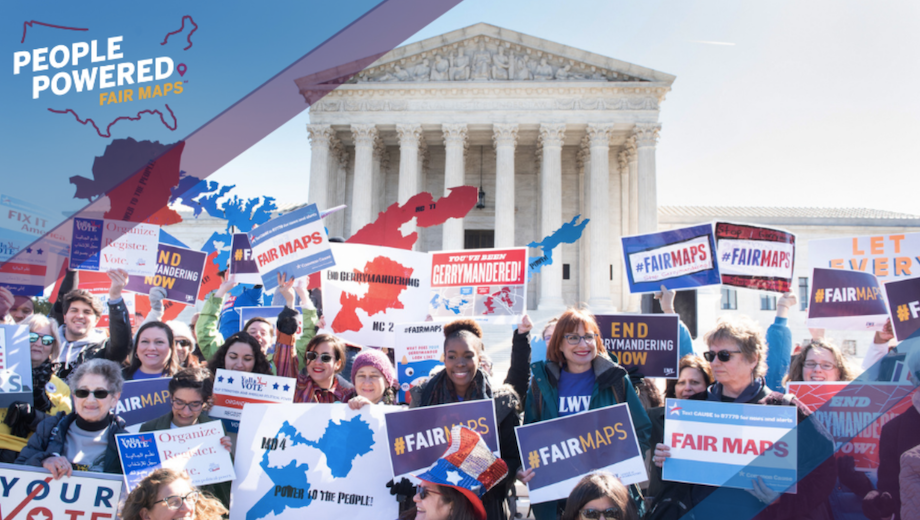
In 2019, we launched the People Powered Fair Maps™ (PPFM) program to advocate for the creation of equitable, accurate maps in all 50 states and DC and to educate about redistricting and increase public engagement in the 2021 map drawing process.
People Powered Fair Maps™ focuses on:
- Ensuring equity and transparency in the map-drawing process
- Advocating for independent redistricting commissions and the integrity of existing commissions
- Pushing for restoration of the Voting Rights Act of 1965
- Monitoring and protecting the “free and fair” clause in state constitutions
- Increasing education and public engagement in the community districting process
New Laws For Fair Redistricting
There are efforts at the state and federal level to create a fair and consistent redistricting process nationwide. We support legislation that would restore the Voting Rights Act to its full power.
Take Action
- Follow the People Powered Fair Maps™ program on League in Action to stay up to date on ways to remain engaged on national and local activities.
- Spread the word about redistricting to friends and family by sharing the page on social media.
Join Your Local League
Connect with your local League of Women Voters and learn how you participate in the map drawing process.
LWVUT and its partners moved to intervene to defend Utah’s fair congressional maps, which replaced a prior illegal gerrymander against a claim under the rejected “Independent State Legislature” theory
LWVTN filed a federal lawsuit challenging Tennessee’s post-Callais racial gerrymander, which would deny the people of Memphis, the country’s largest majority-Black city, the ability to elect a candidate of their choice.
The League of Women Voters of the United States and the League of Women Voters of Alabama issued the following statement in response to the US Supreme Court’s decision to allow Alabama to use the Legislature's gerrymandered 2023 congressional map for the 2026 election cycle.
Sign Up For Email
Keep up with the League. Receive emails to your inbox!
Donate and support our work
to build equitable community district maps and end gerrymandering.