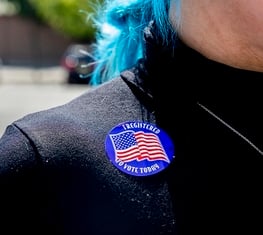
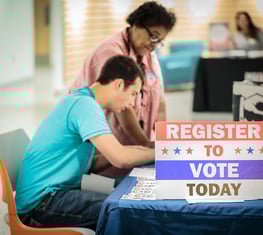
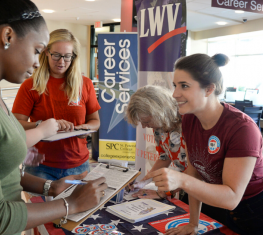

We pulled US Census to get a snapshot of how women are voting. It made one thing clear: the next election is up to women.
See our map showing the power of women voters in 2022 and our graph on registered voters from 2004-2022 by the numbers.
We polled LWV staff on which songs excited them to cast their ballots.
Voters deserve to hear directly from the candidates campaigning to represent us at the highest level.
See which candidates have filled out our voter guides and demand the rest follow their example!
Ahead of the 2024 midterms, LWV's latest Public Service Announcement's for VOTE411.org are live!
The Hyde Amendment prohibits the use of federal funding for most abortions. As a result, most people enrolled in public health programs cannot use their health care coverage to pay for abortion services. This poses a particularly devastating barrier to people living with low incomes, including the more than 16 million women of reproductive age enrolled in Medicaid.
Ensuring elections are fair and equitable includes maintaining clean and accurate voter rolls.
The Electronic Registration Information Center (ERIC) is a nonpartisan membership organization comprised of state election officials from around the United States who have chosen to opt into ERIC, and the states that do so make up ERIC's funding. At this time, 26 states and Washington, DC, are members.
In 2023, US and DC League members joined other leaders in the movement for DC Statehood to honor the holiday and discuss how statehood is both a human rights and racial justice issue.
Led by moderator Nile Blass, panelists included:
- Virginia Kase Solomón, LWVUS
- Jason Fink, DC Office of Federal and Regional Affairs
- Jamal Holtz, 51 for 51
- Dr. George Derek Musgrove, DC Vote, co-author of Chocolate City: A History of Race and Democracy in the Nationa's Capital
- Philip Panel, Anacostia Coordinating Council
Find and compare candidate and election info using our new tool!
Individual voter challenges occur when a person’s eligibility to vote is questioned. Across the country, ithey have been a vehicle for race- and language-based discrimination, election confusion, and voter suppression.
In the last decade, the US Supreme Court has severely weakened the Voting Rights Act of 1965, which was widely agreed to be the most influential civil rights law in our history.
This term, the Court considers Section 2 in Merrill v. Milligan (now Allen v. Milligan). It threatens to weaken a well-established precedent lower courts have used for decades to evaluate redistricting plans alleged to be racially discriminatory.
This blog explores the history of Section 2 and its impact on discriminatory redistricting plans, explains the dispute in Milligan, and previews potential next steps to protect voting rights.